As Shenzhen hosts APEC 2026, its blend of Lingnan spatial culture, green compliance, and smart venues offers a practical blueprint for international buyers specifying hospitality and contract furniture from Guangdong's Greater Bay Area.
As Shenzhen hosts APEC 2026—with the APEC CEO Summit 2026 bringing together more than 2,000 business and political representatives in the city—its diplomatic and hospitality venues are drawing international attention. Provincial preparatory officials stated ahead of the meetings that organizers incorporated green practices, traditional Chinese and local Lingnan culture, and digital technologies into venue preparations and services. For hoteliers, interior architects, and corporate procurement teams watching from abroad, that brief points to a practical design question: how do you translate those three priorities into durable, compliant contract furniture when sourcing from China's Greater Bay Area?
Translating Lingnan Architecture into Tactile Restraint
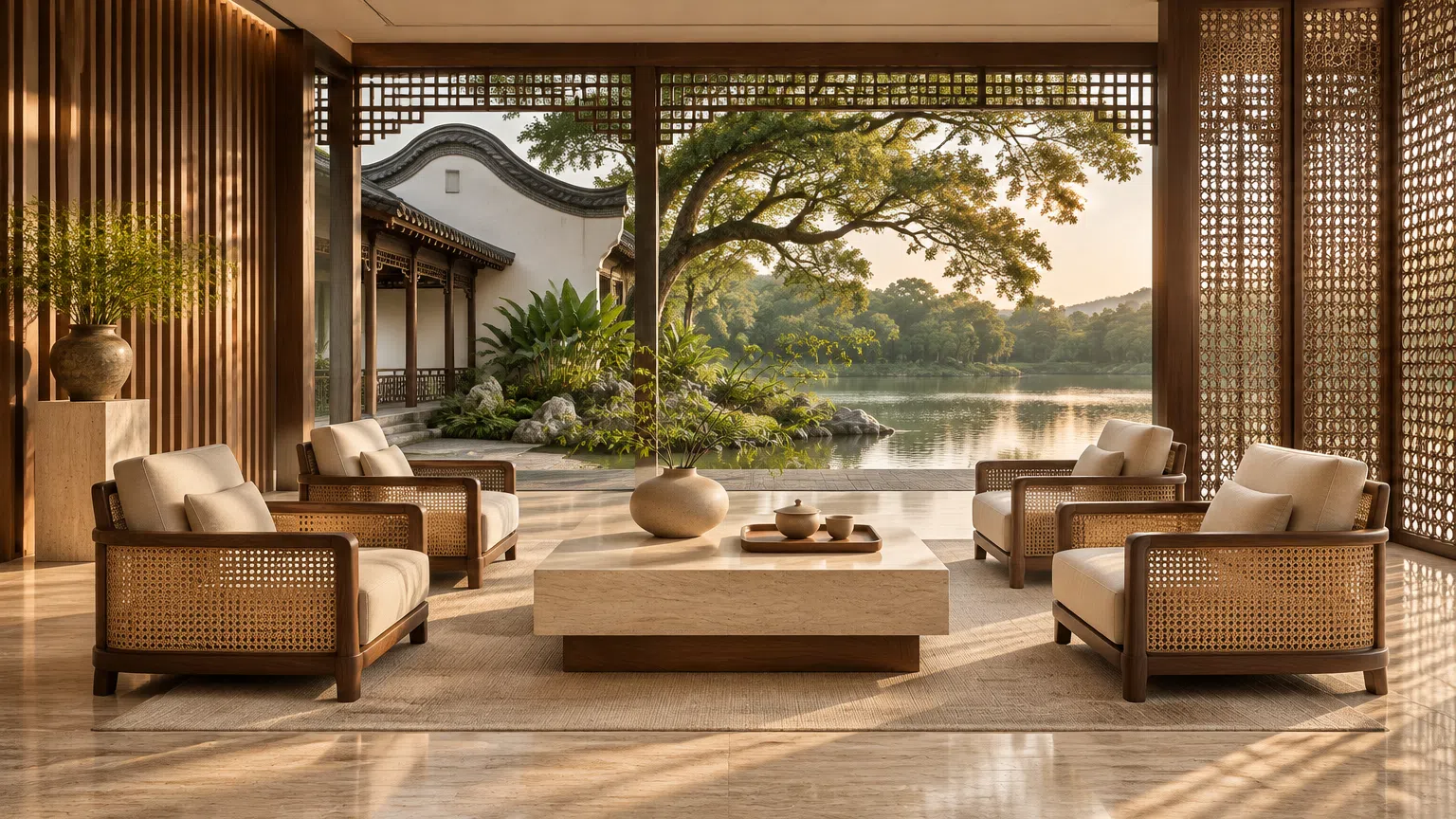
In contemporary Shenzhen civic architecture, flagship conference venues show how southern Chinese hospitality moves past literal ornamentation. Ceremonial entrance halls and high-end conference spaces in the city integrate landscape gardens, Lingnan architecture, and digital technology to convey etiquette and hospitality with an oriental flair. Rather than relying on heavy carved motifs, modern Lingnan-inspired interiors can establish regional character through filtered daylight, calm horizontal sightlines, and honest natural materials.
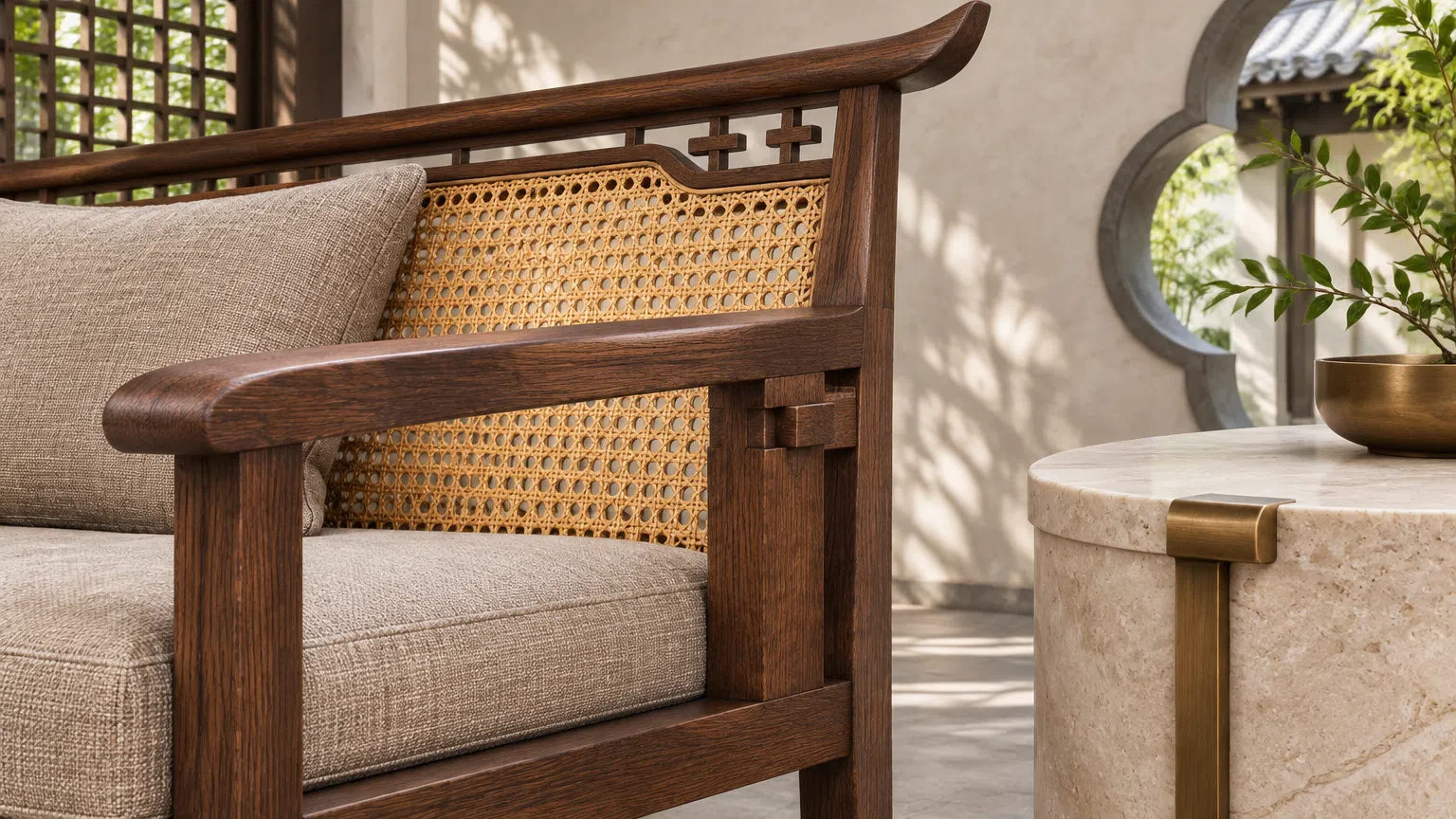
A recent hospitality benchmark in neighboring Huizhou illustrates how that architectural language translates directly to room-level furniture specifications. At Sanshan Laichi Xialang Valley Retreat, Studio InTo paired warm-toned textured paint with dark solid wood furniture, warm white stone, and semi-transparent ramie partitions. When specifying lounge or executive reception seating for humid coastal climates or high-traffic lobbies, designers can adopt a similar material balance: low-slung dark timber frames that anchor a space visually, breathable woven cane or textile panels that keep visual mass light, and honed stone tables that handle heavy daily service without looking industrial.
FREE
Have a Design Project?
We'll Source All the Furniture and Decor
Send us your spec sheet or rendering, and we'll match every piece of furniture and decor to your design
FREE
Have a Design Project?
We'll Source All the Furniture and Decor
Send us your spec sheet or rendering, and we'll match every piece of furniture and decor to your design
FREE
Have a Design Project?
We'll Source All the Furniture and Decor
Send us your spec sheet or rendering, and we'll match every piece of furniture and decor to your design
Building Commercial Durability Beneath a Calm Profile
Soft silhouettes and natural textures should never be confused with light residential construction. In commercial sourcing, contract furniture is built to pass published strength and fire tests—such as ANSI/BIFMA X5.4 and EN 16139—carry a 2–5 year warranty, and run in project quantities. When reviewing factory samples for public lounges or executive meeting rooms, buyers should separate styling from engineering: specify kiln-dried timber or steel internal frames, commercial-grade high-resilience foam, reinforced joinery, and high-traffic upholstery, and require third-party test reports matching the destination market's fire and durability rules before signing off on production.
Verifying Low-Emission Finishes with Measurable Limits
Sustainability was placed alongside culture and technology in Shenzhen's APEC 2026 venue preparations, reflecting stricter environmental baselines across Chinese furniture manufacturing. Under China's mandatory national standard GB 18584-2024 ("Limits of Harmful Substances in Furniture"), indoor furniture faces explicit limits for formaldehyde, benzene, toluene, xylene, and total volatile organic compounds (TVOC). Rather than accepting generic eco-friendly labels on wood stains or adhesives, international buyers should write GB 18584-2024 lab documentation—or equivalent destination VOC certificates—directly into purchase contracts prior to bulk finishing.
Coordinating Greater Bay Area Design and Production
With more than 2,000 business and political representatives convening in Shenzhen for the APEC CEO Summit 2026, regional connectivity across Guangdong is once again in focus for project buyers. Within that manufacturing landscape, China's Foshan–Dongguan corridor supplies most of the country's export contract furniture, pairing specialized custom production with southern China's broader design ecosystem. To translate executive or hospitality concepts into reliable deliveries, buyers should lock first-article prototypes, stone-sealer samples, concealed cable-routing details, and compliance test reports before approving mass production.
Concept detail of Lingnan-inspired contract materials: dark timber joinery, breathable woven cane, textured upholstery, and honed stone paired with brushed bronze.